YAN is a critical component for healthy and complete fermentation, and it directly impacts the final characteristics of a wine. Therefore it can be important to test and control its levels.
- Ensures proper fermentation: Yeast needs nitrogen to grow and stay active. Winemakers measure YAN levels in the grape juice (must) before and during fermentation to ensure the yeast has enough nutrients to convert sugar into alcohol.
- Prevents stuck fermentation: A deficiency in YAN can cause a “stuck” or sluggish fermentation, which negatively affects the wine’s final quality.
- Influences aroma and style: YAN levels can affect a wine’s flavor profile. For example, some studies suggest that moderate YAN can produce more clean and fruity aromas in young wines.
- Impacts spoilage risks: Insufficient YAN creates a “nutrient desert” for spoilage organisms, which can be desirable. However, too much inorganic nitrogen can also increase the risk of off-flavors, such as ester taint.
- YAN is simple to measure with Vinmetrica’s reagents, allowing easy adjustment of levels.
Yeast assimilable nitrogen is an important nutrient in fermentation of wines, beers, and other juices. If
levels are too low, fermentation may stop prematurely, and/or off odors can develop (mostly from
generation of hydrogen sulfide – “rotten egg” smell). To prevent this, you may need to add supplements like DAP or other yeast nutrients before and/or during fermentation. Many yeast and nutrient manufacturers follow a study by the UC Davis Department of Viticulture and Enology relating optimal YAN levels (in milligrams of nitrogen per liter, mg N/L) to wine’s brix level at harvest:
21°Bx = 200 mg N/L 25°Bx = 300 mg N/L
23°Bx = 250 mg N/L 27°Bx = 350 mg N/L
How to measure YAN
So how do you measure your YAN levels? With the Vinmetrica YAN kit, it’s pretty simple:
- A 10 mL wine sample is titrated to pH 8.2 with Vinmetrica’s TA Titrant (this gives the TA value as a bonus).
- The YAN reagent (a special formulation of formaldehyde) is added. This causes any nitrogen (in the needed forms of amino groups or ammonia) to release one proton per amine/ammonia, lowering the pH.
- The sample is then titrated back to 8.2 as before.
- The YAN value, in mg/L, is calculated from the volume of TA Titrant used in the second titration.
When to measure and adjust YAN?
- At fermentation start (SG 1.09 – 1.11). Note that you will probably add yeast energizer or starter, e.g. GO-FERM, to activate your yeast, and Fermaid K or similar after pitching yeast. These usually provide sufficient YAN. Measure if in doubt. You can make further adjustments with Fermaid or diammonium phosphate (DAP). Avoid adding add DAP above 0.5 g/L.
- At 30% completion of fermentation (SG 1.06 – 1.08, 3 to 5 days typically). Make additions if needed with DAP or Fermaid K or O.
- DON’T add YAN after ~50% completion (i.e. ~12 Brix or SG 1.050).
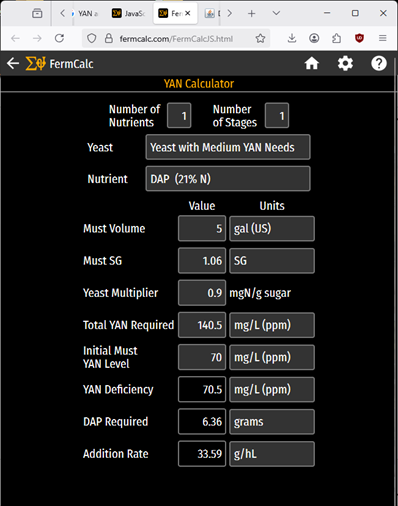
NOTE: Use FermCalc (www.fermcalc.com) to guide you in making additions with DAP, Fermaid, or other nutrient sources. Shown below is the calculation for 5 gal of juice at a specific gravity of 1.06, whose measured YAN was 70 mg/L, showing that 6.36 g of DAP is needed in this case