Posted on — Leave a comment

Common Winemaking Issues Part II: Is Your Wine Balanced? The Hidden Role of pH and (Titratable) Acidity

To view as a printable PDF, click here.

The Balancing Act: Why Acidity Rules

Every winemaker wants to craft a bottle that tastes professional. Yet, many beginner winemakers and small wineries find themselves occasionally struggling with a batch that feels “off.”

Acidity is the structural spine of your wine. When it is out of balance, your flavor profile collapses, your wine becomes vulnerable to spoilage, and your sulfite additions lose their effectiveness. You simply cannot fix what you do not measure.

Common Winemaker Pain Points

Many winemakers experience the structural symptoms of an acid imbalance without realizing what is actually causing them:

  • The “Flabby” or Flat Batch: Your wine lacks brightness, tastes muddy, or feels lifeless on the tongue because the acid is too low.
  • The “Sour Battery Acid” Batch: The wine is aggressively sharp, green, and causes an unpleasant pucker that masks all fruit characteristics because the acid is too high.
  • The Sulfite Mystery: You add the recommended dose of metabisulfite, but your wine still develops off-flavors, films, or signs of bacterial spoilage because a high pH rendered the sulfites useless.

Keep Reading More!

Posted on — Leave a comment

Importance of Grapes in winemaking

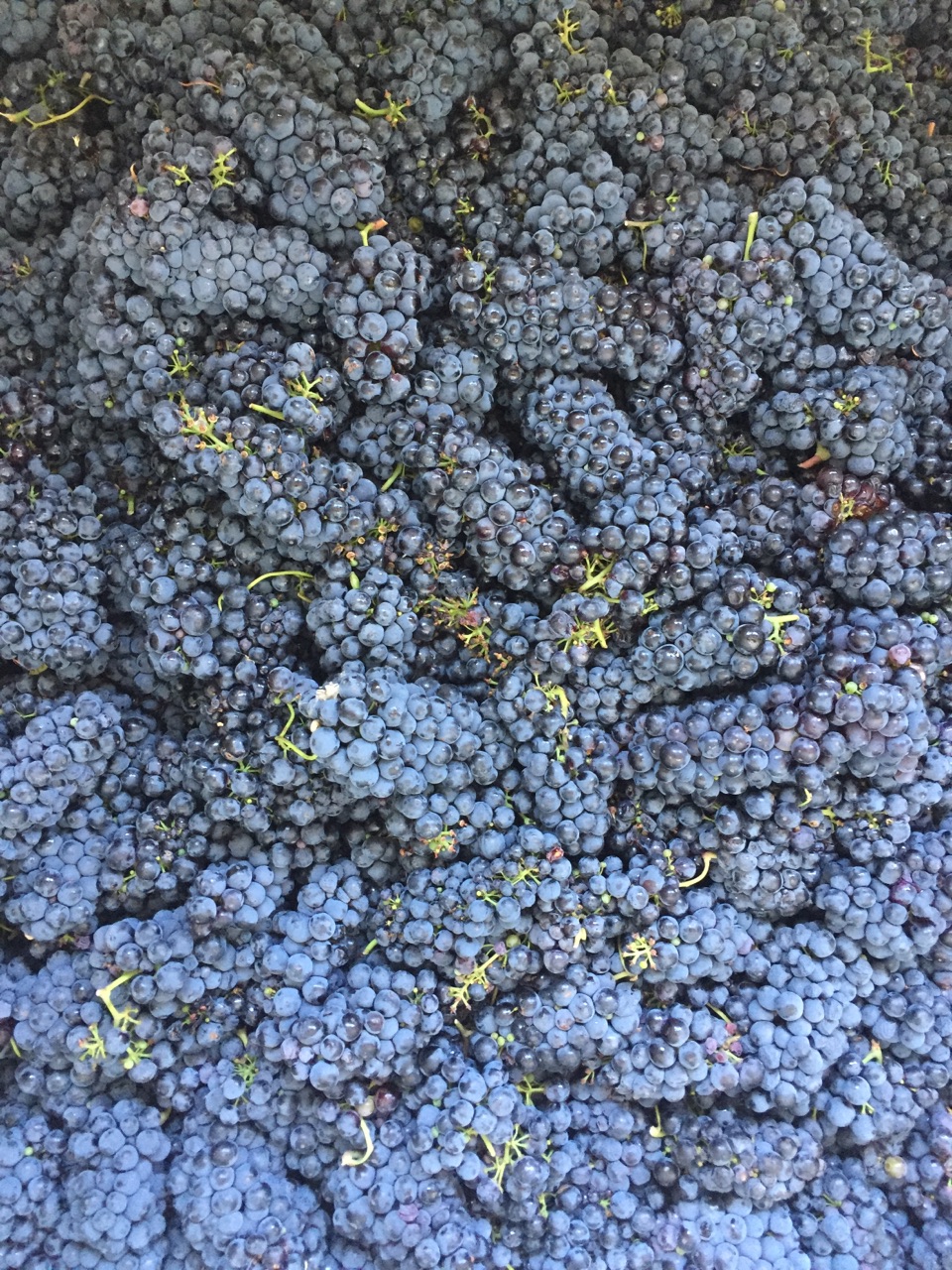
close up of hundreds of red grape clustersWhen it comes to making exceptional wine, it’s easy to focus on the equipment, techniques, and chemistry in the cellar. But seasoned winemakers know the truth: great wine isn’t made—it’s grown.

The quality of your vineyard and grapes sets the foundation for everything that follows. No amount of adjustment or analysis can fully compensate for poor fruit, while high-quality grapes often require less intervention and yield more expressive, balanced wines.

Every vineyard has its own unique combination of soil, climate, elevation, and sun exposure. These factors shape how grapes develop, influencing sugar levels, acidity, tannins, and aromatic compounds.

Grapes grown in well-suited vineyard sites tend to ripen more evenly and develop greater complexity. Balanced conditions—neither too harsh nor too fertile—encourage vines to produce fruit with concentrated flavors rather than excessive yields.

It’s important to evaluate the vineyard as a whole—ensuring the fruit is ripening properly and that the grower is actively managing the vines to prevent damage. While we have limited experience growing grapes ourselves, we’ve spent many harvests hand-picking and have seen our fair share of both care and neglect.

If you are a newer home winemaker and are using one of the many wine kits available, these are generally set up so that you can get through primary fermentation without any adjustments or additions. It is common for pH and TA measurements to be supplied by the maker of the kit.

How Testing Fits In

Keep Reading More!

Posted on — Leave a comment

The importance of YAN (Yeast Assimilable Nitrogen) in winemaking

YAN is a critical component for healthy and complete fermentation, and it directly impacts the final characteristics of a wine.  Therefore it can be important to test and control its levels.

  • Ensures proper fermentation: Yeast needs nitrogen to grow and stay active. Winemakers measure YAN levels in the grape juice (must) before and during fermentation to ensure the yeast has enough nutrients to convert sugar into alcohol.
  • Prevents stuck fermentation: A deficiency in YAN can cause a “stuck” or sluggish fermentation, which negatively affects the wine’s final quality.
  • Influences aroma and style: YAN levels can affect a wine’s flavor profile. For example, some studies suggest that moderate YAN can produce more clean and fruity aromas in young wines.
  • Impacts spoilage risks: Insufficient YAN creates a “nutrient desert” for spoilage organisms, which can be desirable. However, too much inorganic nitrogen can also increase the risk of off-flavors, such as ester taint.
  • YAN is simple to measure with Vinmetrica’s reagents, allowing easy adjustment of levels.

Yeast assimilable nitrogen is an important nutrient in fermentation of wines, beers, and other juices. If

levels are too low, fermentation may stop prematurely, and/or off odors can develop (mostly from

generation of hydrogen sulfide – “rotten egg” smell).  To prevent this, you may need to add supplements like DAP or other yeast nutrients before and/or during fermentation. Many yeast and nutrient manufacturers follow a study by the UC Davis Department of Viticulture and Enology relating optimal YAN levels (in milligrams of nitrogen per liter, mg N/L) to wine’s brix level at harvest:

21°Bx = 200 mg N/L              25°Bx = 300 mg N/L

23°Bx = 250 mg N/L              27°Bx = 350 mg N/L

How to measure YAN

So how do you measure your YAN levels?   With the Vinmetrica YAN kit, it’s pretty simple:

  1. A 10 mL wine sample is titrated to pH 8.2 with Vinmetrica’s TA Titrant (this gives the TA value as a bonus).
  2. The YAN reagent (a special formulation of formaldehyde) is added. This causes any nitrogen (in the needed forms of amino groups or ammonia) to release one proton per amine/ammonia, lowering the pH.
  3. The sample is then titrated back to 8.2 as before.
  4. The YAN value, in mg/L, is calculated from the volume of TA Titrant used in the second titration.

When to measure and adjust YAN?

  1. At fermentation start (SG 1.09 – 1.11). Note that you will probably add yeast energizer or starter, e.g. GO-FERM, to activate your yeast, and Fermaid K or similar after pitching yeast. These usually provide sufficient YAN.  Measure if in doubt. You can make further adjustments with Fermaid or diammonium phosphate (DAP).  Avoid adding add DAP above 0.5 g/L.
  2. At 30% completion of fermentation (SG 1.06 – 1.08, 3 to 5 days typically). Make additions if needed with DAP or Fermaid K or O.
  3. DON’T add YAN after ~50% completion (i.e. ~12 Brix or SG 1.050).

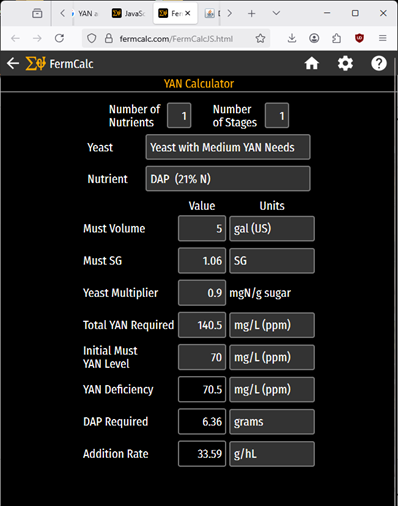
NOTE: Use FermCalc (www.fermcalc.com) to guide you in making additions with DAP, Fermaid, or other nutrient sources.  Shown below is the calculation for 5 gal of juice at a specific gravity of 1.06, whose measured YAN was 70 mg/L, showing that 6.36 g of DAP is needed in this case

fermcalc yan calculator

Posted on — Leave a comment

Who are we?

You all know by know what our company does. Have you heard the story of how we started? Officially opening up in January 2010, Vinmetrica was founded on the belief that Rich could put together products that would help winemakers like him. After a series of events involving several years of working as a research scientist at Eli Lilly, a move to Northern California and eventually an over abundance of apricots off a tree in Rich’s new backyard, the idea for Vinmetrica was born.

Rich followed the typical progression of the home winemaker we still encounter today. He began making apricot jam but had so much excess fruit that he decided to try his hand at winemaking and the eventual study of fermentation chemistry. Graduating from fermenting fruit to condensed juices, then to wine kits and finally to grapes. After a while he was confronted with the task of measuring sulfite levels.

With a background in analytical chemistry, Rich had a thorough understanding of measuring sulfite levels via the Ripper titration method and after a quick visit to a local winemaking store Rich returned with some Chemetrics Titrets. Despite knowing that they were not all that suitable for red wines, Rich kept trying to use them for a whole season before finally giving up… Determining the endpoint was not reproducible. There had to be another way!

Eventually landing on the iodine titrations Rich had done as an undergraduate he remembered how he could see a faint yellow iodine color about the same time as his cobbled together electrode system read an endpoint. This was all a lesson in using electrochemistry to detect an endpoint rather than a color indicator. And thus Vinmetrica, or at least the idea for it, was born.

Two platinum electrodes, disused equipment at work, a few components from Fry’s Electronics, and an output that he read with his voltmeter.. that’s how it all started. Wasn’t much to look at, but he found he could get reproducible results in minutes. This was about 1995. He used this setup for years in his garage.

Then, in 2008, after being let go from a position as the VP of Reagents and Assays at Molecular Devices and with a little bit of encouragement from his wife, Rich decided to start Vinmetrica. The company was founded on Rich’s desire to make the vintner’s job easier and more predictable.

His first task was to hire some employees so he hired his two sons (Richie & Tim) to fulfill various positions and needs for the company, as they could pop in and out easily while still attending college. As the company grew, his need for additional employees also grew and he eventually hired one of his step daughters (Karolyn) but she was about to leave for a study abroad program, so he decided to hire his other step daughter (Taylor) to fill the position as she had just graduated from college with a degree in Biology. And finally, the last family hire was Rich’s stepson (Bryan), who joined us for a few years after he graduated college. Throughout the past 13 years, Vinmetrica has only hired one non family member (Rachel). She was with us for several years before moving on to bigger things.

These days, our entire operation is family owned and operated; being completely ran by Rich, Taylor and Tim (with some IT help from Richie occasionally). We have expanded from a small operation selling direct to customers to now having over 10 distributors in the US plus 8 international distributors. Every item we sell comes through the doors of our warehouse in Carlsbad, CA before it is loving packaged and sent out.

When we say we are a small business, we mean it! And we thank our customers each and every day for supporting us! We wouldn’t be here without you.


Posted on — 1 Comment

Vinmetrica – A Brief History

Rich making wine in his garage
By now you know that Vinmetrica has the reputation for providing simple, low cost, fast and accurate tests for winemakers…tools that let you make the best wine you can. In this installment of the winemaker’s blog, we’d like to give a brief account of our origins. Keep Reading More!

Posted on — 2 Comments

The Benefits of Barrel Steaming

As many of you know, Vinmetrica shares a warehouse space with our sister company Little Oaks Winery. After years of private winemaking, our president Rich decided it was time to turn his garage operation into a business. We have grown from a one barrel, garage operation to a small winery producing about 350 cases a year.

Our winery has anywhere between 18-24 barrels at once and we were looking for a more efficient and cost effective way to clean our barrels and tanks after bottling. We followed all the usual methods and found that we were either using up too much water, potentially adding odd flavors to our barrels from the use of harsh chemicals, and we weren’t exactly sure if our barrels were getting clean. It dawned on us that we needed to find a better solution, and fast. We eventually determined that barrel steaming was the best way to go.

So what are the benefits of barrel steaming? Keep Reading More!