

To view as a printable PDF, click HERE
Vinmetrica has been around since 2010 and over the past 16 years we have seen, heard, and learned about pretty much every common problem as it pertains to winemaking. Although we mostly help out with technical support using our Vinmetrica SC series systems, we do occasionally get a call about helping with winemaking issues. We cover many topics on our blog but we thought it might be a good idea to go through several of the most common problems we hear about. At our sister company, Little Oaks Winery, we have run into our fair share of problems too. Over the course of the next few months, we are going to visit and re-visit some of the most common winemaking issues and discuss how to prevent, diagnose, and how to move forward with a plan to turn the fate of your wine around.
We will cover topics like oxidation, off flavors, and haze issues but first we thought it best to go over stuck fermentations. Harvest is coming soon and this is one of the most common issues we hear about and see on winemaking forums and guides. If we missed anything, please do let us know in the comments below.
(If this is your first time looking at our blog, we do regularly send out newsletters with links to our newest blog articles. Subscribing is the best way to stay up to date. You can do that using the signup box on our homepage.)
Stuck Fermentations: How to Prevent, Diagnose, and Restart Primary and Secondary Fermentations
Every winemaker has experienced that moment of concern: fermentation slows to a crawl, stops unexpectedly, or never starts properly in the first place. Whether it occurs during primary alcoholic fermentation or secondary malolactic fermentation (MLF), a stuck fermentation can lead to spoilage risks, unwanted microbial growth, off-aromas, and delayed production schedules.
The good news? Most stuck fermentations are preventable—and recoverable—when you understand the underlying causes and use the right analytical tools to diagnose the problem. You can’t fix what you don’t measure.
What Is a Stuck Fermentation?
A stuck fermentation occurs when yeast or bacteria stop converting their target substrate before the process is complete.
In primary (alcoholic) fermentation, yeast convert grape sugars into alcohol with carbon dioxide (CO2) as a byproduct. Primary fermentation is considered stuck when the Brix remains above a desired endpoint, fermentation activity ceases and residual sugar remains in the wine.
In secondary (malolactic) fermentation, malolactic bacteria convert malic acid into lactic acid, also with CO2 as a byproduct. Secondary fermentation is considered stuck when malic acid levels stop decreasing, the conversion from malic to lactic is incomplete, and/or MLF never starts despite inoculation.
Preventing Primary Fermentation Problems
The best solution is prevention. Before inoculating yeast, evaluate the must to ensure it provides a healthy environment for fermentation. There are 4 parameters we recommend you know before inoculating the yeast. These are: Sugar (Brix), pH, TA, and Yeast Assimilable Nitrogen (YAN).
NOTE: Use an app like Ferm-Calc to interpret data and to help make accurate decisions about any additions of sugar, YAN, pH and TA!
- Sugar (Brix): Extremely high sugar levels create osmotic stress for yeast.
| <22 | Relatively low alcohol content |
| 22-26 | Ideal range |
| 27-29 | Moderate stress |
| 30+ | High risk of stuck fermentation |
Solutions:
If too low:
- Yeast are not generally stressed by low sugar levels. If the predicted alcohol level is lower than you intend, you can add sugar. Let Ferm-Calc guide you.
If too high:
- Dilute it. Using pure water will reduce the acidity and this is not generally desirable; better is to dilute with “acidulated” water, e.g. water that has tartaric acid added to it. Adjust the TA and pH of the acidulated water to be close to that of the must.
- Use high-alcohol-tolerant yeast strains
- Consider staggered nutrient additions
- pH: pH strongly influences yeast health and microbial stability. Always evaluate TA and pH together.
Recommended Range
- White wines: 3.1–3.4
- Red wines: 3.3–3.6
Problems
Low pH:
- Yeast stress
- Slower fermentation
High pH:
- Increased spoilage risk
- Bacterial competition
Solutions
In general, you should proceed cautiously to avoid unintended over -acidification or deacidification, which can permanently ruin your product. A good idea is to take exactly 100 mL of the wine or must and perform trial additions on this to achieve the target pH value. Then scale up that amount to your whole volume.
If too low:
- Typically one will add calcium carbonate, potassium carbonate, or potassium bicarbonate to “deacidify” or raise the pH of a must or wine.
If too high:
- High pH wines can be tricky, especially if TA levels are also on the high side, because there is resistance to lowering pH due to the buffering effect frequently seen in high pH wines. Addition of tartaric acid is a common way to acidify or lower pH.
- Titratable Acidity (TA): While pH measures the strength of acidity, Titratable Acidity (TA) measures the total concentration of acids present in the must or wine. Together, pH and TA provide a much more complete picture of fermentation conditions than either measurement alone. TA affects: yeast performance, microbial stability, wine balance and sensory perception, secondary (malolactic) fermentation success, and long-term aging potential.
Recommended Range
The ideal TA depends on grape variety, wine style, and climate, but general guidelines are:
| Wine Style | Recommended TA |
| White wines | 6.0–9.0 g/L |
| Red wines | 5.5–8.0 g/L |
| Warm climate grapes | Often 4.5–6.5 g/L |
| Cool climate grapes | Often 7.0–10.0 g/L |
Remember that TA will typically decrease during fermentation and may decrease further if malolactic fermentation is completed.
Problems:
Low TA:
- Elevated pH
- Poor microbial stability
- Flat or flabby wine
High TA
- Yeast stress
- Harsh acidity
- Difficult malolactic fermentation
Solutions – be sure to also monitor the pH change when making any modifications to TA!
If too low:
- Raise TA levels using tartaric acid (most common), being sure that pH does not drop too far. Add calcium or potassium carbonate to bring pH up if needed.
If too high:
- Monitor pH carefully
- Consider deacidification using chemicals or blending
- Use MLF strategically
Many MLF problems occur not because TA itself is high, but because the associated pH is too low for bacterial growth.
- Yeast Assimilable Nitrogen (YAN): One of the most common causes of stuck fermentation is inadequate nitrogen. Yeast require nitrogen to reproduce and remain metabolically active.
Low YAN Symptoms
- Slow start to fermentation
- Sulfur odors
- Fermentation stalls out
Recommended Range
- 150–250 mg/L for most fermentations
- Higher for elevated Brix musts
Solutions
If too low:
- Diammonium phosphate DAP or other additions can raise YAN but do not add DAP or other nitrogen sources after fermentation is 40 % complete or more.
- Complex yeast nutrients
- Staggered nutrient programs
Signs That Primary Fermentation May Become Stuck
Watch for:
- Fermentation temperature dropping unexpectedly
- Brix decline slowing dramatically
- Sulfur (rotten egg) aromas
- Minimal CO₂ production
- Yeast settling prematurely
Early intervention is far easier than restarting a completely stuck fermentation.
Diagnosing a Stuck Primary Fermentation
When fermentation stops unexpectedly, resist the urge to immediately add more yeast.
First determine why the fermentation stopped.
Step 1: Measure Residual Sugar
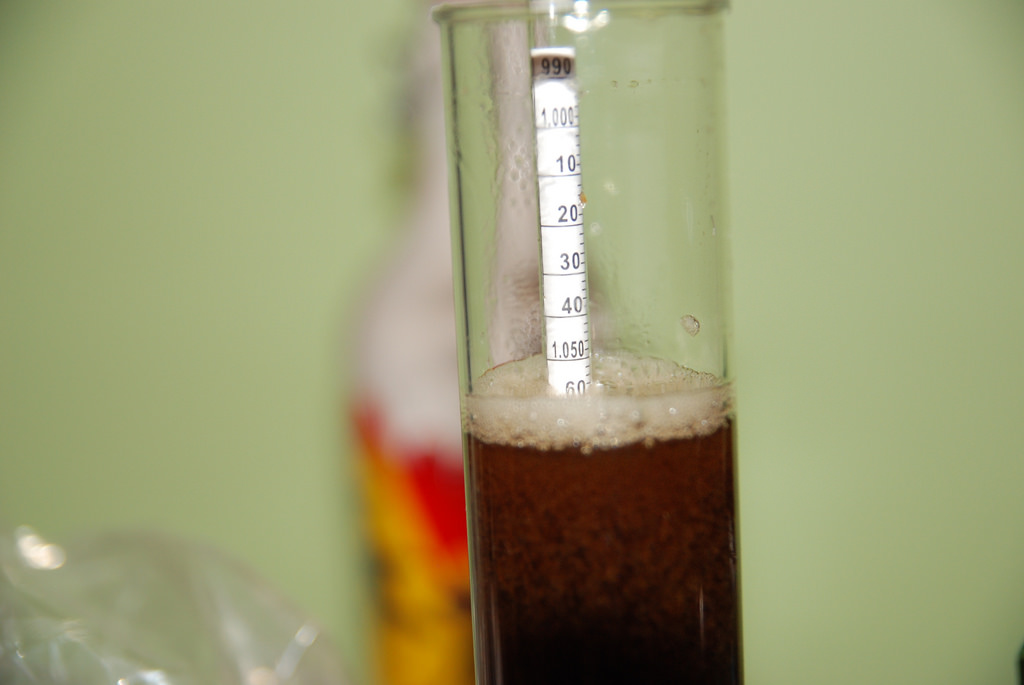
Determine whether fermentation is truly stuck. Measure specific gravity, rather than Brix, at this point. Or use Vinmetrica’s Residual Sugar Reagent Test Kit
Typical indicators:
- Specific gravity above 1.000
- Significant residual sugar present (> about 30 g/L )
Step 2: Measure pH and TA
Unexpected pH shifts can stress yeast and favor competing microbes.
Vinmetrica’s SC-200 pH/TA Analyzer Kit OR SC-300 SO2, pH/TA Analyzer Kit
Step 3: Evaluate Temperature
Most wine yeast perform best between:
- 60–85°F (15–29°C)
Common problems:
Too Cold
Yeast become dormant.
Correction:
Gradually warm the fermenting wine.
Too Hot
Temperatures above 90°F (32°C) may kill or severely stress yeast.
Correction:
Cool the wine and prepare for re-inoculation if necessary.
Step 4: Consider Alcohol Toxicity
As alcohol increases, yeast experience increasing stress.
This is especially common when:
- Initial Brix was very high
- Fermentation was nutrient deficient
If alcohol tolerance has been exceeded, a restart culture may be necessary.
Or you may leave some residual sugar if the taste suits you.
How to Restart a Stuck Primary Fermentation
The correct strategy depends on the cause.
Scenario 1: Fermentation Is Simply Too Cold
Symptoms:
- Residual sugar present
- Healthy yeast population
- Low temperature
Solution:
- Warm to 68–75°F
- Gently mix yeast back into suspension
Often fermentation resumes naturally.
Scenario 2: Nutrient Deficiency
Symptoms:
- Slow fermentation
- Sulfur odors
- Low YAN history
Solution:
- Add appropriate nutrients
- Mix thoroughly
- Monitor daily Brix decline
Avoid excessive DAP late in fermentation (after Brix has dropped).
Scenario 3: Yeast Population Collapse
Symptoms:
- No visible activity
- Significant residual sugar
- High alcohol environment
Solution:
- Prepare a restart culture using a robust yeast strain.
- Acclimate the culture gradually to the wine.
- Slowly blend increasing portions of stuck wine into the starter.
- Add the acclimated culture back into the tank.
Directly pitching dry yeast into a stuck wine rarely succeeds.
Understanding Malolactic Fermentation (MLF)
MLF is biologically very different from primary fermentation.
Instead of yeast consuming sugar, bacteria convert:
Malic Acid → Lactic Acid + CO₂
This process softens acidity and improves microbial stability.
Co-inoculation vs. secondary fermentation:
There are two main approaches to carrying out MLF: co-inoculation and secondary fermentation. In a co-inoculation procedure, malolactic bacteria are added simultaneously or shortly after the yeast, whereas in secondary MLF, the bacteria are added after primary/yeast fermentation is complete. Each procedure has its advantages. With co-inoculation, the MLF bacteria get a head-start since initial alcohol and SO2 levels are low. The entire fermentation period is shorter so there is less chance of microbial spoilage. Secondary MLF can be useful for higher pH wines and/or where experience shows that the flavor profile is improved.
Preventing Stuck MLF
The most important step is verifying that conditions are favorable before inoculation.
Test #1: Malic Acid
Measure malic acid before inoculation. Typically this will be above 1.0 g/L
This establishes:
- Whether MLF is needed
- Starting concentration
- Progress throughout MLF
Without testing, it’s impossible to know whether MLF is complete.
Test #2: pH
Malolactic bacteria are highly sensitive to pH.
Risk Zones
Below pH 3.1:
- MLF may struggle or fail
Above pH 3.8:
- Increased spoilage risk
Ideal range:
- Approximately 3.3–3.6
Test #3: Free SO₂
One of the most common reasons MLF never starts.
Excess sulfur dioxide inhibits bacteria.
Before inoculation:
- Verify free SO₂ is not excessive (less than 10 ppm for most MLF strains)
- Follow bacterial supplier recommendations
Test #4: Temperature
MLF generally performs best between:
- 65–75°F (18–24°C)
Cool cellar temperatures commonly cause sluggish MLF.
Diagnosing a Stuck MLF
If malic acid is not decreasing:
First Measure Malic Acid
This is the single most important test. Target levels at completion are less than 50 mg/L typically
Questions to answer:
- Did MLF ever begin?
- Has it partially progressed?
- Has it completed already?
Testing removes guesswork. Vinmetrica’s SC-50 MLF Analyzer Kit
How to Restart a Stuck MLF
Scenario 1: Temperature Is Too Low
Raise wine temperature into the recommended range.
Many MLFs restart within days.
Scenario 2: Excess SO₂
Allow free SO₂ to decline naturally before re-inoculation.
Always verify levels analytically before attempting another inoculation.
Scenario 3: Low pH
Some bacterial strains tolerate lower pH than others.
In difficult cases:
- Use a low-pH-tolerant culture
- Consult supplier recommendations
Scenario 4: High Alcohol Wine
Select bacteria specifically designed for:
- High alcohol
- Low pH
- Challenging red wines
The Most Important Tests for Preventing Stuck Fermentations
Whether dealing with primary or secondary fermentation, these measurements provide the information needed to prevent problems before they occur:
Before Primary Fermentation
✓ Brix
✓ pH
✓ Titratable Acidity (TA)
✓ YAN (if available)
During Primary Fermentation
✓ Daily Brix or specific gravity tracking
✓ Temperature monitoring
✓ pH checks when problems appear
Before MLF
✓ Malic Acid
✓ pH
✓ Free SO₂
During MLF
✓ Malic Acid monitoring
✓ pH monitoring
✓ Free SO₂ monitoring
Final Thoughts
Most stuck fermentations are not random events—they are the result of measurable conditions that stress yeast or malolactic bacteria. Regular testing allows winemakers to identify risks before fermentation begins, monitor progress during fermentation, and quickly diagnose problems when they arise.
By tracking critical parameters such as pH, TA, free SO₂, and malic acid, winemakers can dramatically reduce the likelihood of stuck fermentations and make informed decisions when intervention is needed.
For winemakers, the best restart strategy is often prevention—and prevention starts with testing.
Did we miss anything? Let us know in the comments below.
Good refresher on starting a fermentation.