Posted on Leave a comment

Malolactic Fermentation – An Overview

Malolactic fermentation (MLF) is typically carried out in most red wines and in some white varietals.  MLF plays an important role in the finished wine’s feel and taste. MLF reduces acidity and produces flavors often characterized as “soft” or “buttery”.  In addition, carrying out MLF before bottling prevents an unintended development of carbon dioxide gas (CO2) due to MLF starting up in the bottle, which can lead to fizzy wine, or worse, exploding bottles!

Malolactic fermentation uses the beneficial bacterium Oenococcus oeni (O. oeni) to convert malic acid to lactic acid, and CO2:

Malic Acid                       O. oeni           Lactic Acid      +    carbon dioxide

HOOC–CH2–CH(OH)–COOH           CH3–CH(OH)–COOH  +  CO2

Sulfite, as free SO2, inhibits the O. oeni’s activity, so free SO2 levels must be kept low during MLF. This leaves the wine at risk of oxidation and microbial contamination.  As soon as MLF is done, then, SO2 should be raised to appropriate levels for protection of the wine.  Thus it is important to know when MLF is done, and the best way to do this is to measure malic acid levels in the wine.

Should I do MLF?

These days virtually every winery takes its red wines through MLF.  The mellowing tendency of MLF brings out the flavors and complex notes in red wines that are barrel-aged for months and then rested after bottling for a year or more.   Increasingly, white and rosé wines are not taken through MLF, to preserve the crisp flavors and floral aromas that would diminish at the higher temperatures (>70F) needed for MLF.  However, some winemakers prefer the mellowing, buttery flavors introduced by MLF into, say, a Chardonnay or a Muscat.

If you choose NOT to do MLF, bear in mind that your wine may decide to do it for you at any time.  If you keep your SO2 levels properly adjusted, you should not have a problem with spontaneous MLF during bulk/barrel aging.  But once you bottle, free SO2 levels are going to slowly drop to where MLF could start up on its own.  Unless you have sterile-filtered your wine, it’s always possible that a few stragglers of O. oeni , or of some of its less savory lactobacillus relatives, could wake up to a nice malic acid breakfast and start making CO2 in your bottle.

When to start?

At primary: Some vintners like to inoculate for MLF right at or just after the initiation of primary fermentation.  The idea here is that the O. oeni will get going in the presence of yeast and become acclimated to the yeast byproducts and alcohol levels early on.  As alcohol levels rise, there is an increased risk of getting MLF stuck, so this avenue may be good for wines whose expected final ABV is going to exceed 15%.  Since MLF must be carried out at low free SO2 levels, this approach also has the advantage of minimizing the time that the young wine spends at risk of oxidation.

At secondary: This is the approach taken by most vintners.  Once primary fermentation has ceased, the O. oeni doesn’t face a huge population of yeast competing for resources. Also it is possible that in the presence of residual sugar the O. oeni will start to use the sugars instead of the malic acid as a food source, which could lead to off flavors and undesirable affects such as high levels of VA.  At our winery we always start MLF after primary fermentation is done.

Protocol for inoculation

If starting MLF after alcoholic fermentation, most winemakers will first rack the wine off the gross lees to minimize undesirable side products such as H2S (hydrogen sulfide, rotten egg smell). Inoculation can be with either of two popular types of O. oeni; one is considered a direct inoculation variant, where the freeze-dried O. oeni are added directly to the wine, and the other type requires a rehydration step in water for approximately 15 mins before adding to the wine. Along with the O. oeni bacteria themselves there is also ML nutrient available that is typically used in the rehydration step.

How to monitor MLF

As mentioned, it’s important to know when MLF is done so you can raise SO2 levels immediately.  During MLF, malic acid levels will drop from over 1000 mg/L typically, to below 50 mg/L at completion.  Some vintners rely on the pH and TA changes (increase and decrease, respectively) to assess completion of MLF.  However, the danger lies in an MLF that goes part way.  If you have 100 mg/L of Malic Acid left, that is enough to produce fizziness if MLF starts making CO2.  The pH and TA changes are too subtle to be reliable indicators of completion.

There are several ways to monitor the progress of MLF by measuring malic acid levels.  Many wine makers rely on the paper chromatography method.  This is fairly simple to run, and it is semi-quantitative if you run known standards alongside your samples.   The drawbacks are that it involves use of noxious reagents and takes 24 hours generally to complete.  But probably the biggest drawback is lack of sensitivity: it’s difficult to assess levels below about 200 mg/L.  So again there is a risk of miscalling MLF completion and having fizziness or exploding corks and bottles.

Commercial wine analysis labs will typically use HPLC or enzymatic spectrophotometric methods.  These are accurate and sensitive enough, but the instrumentation costs upwards of tens of thousands of dollars.

Accuvin (www.accuvin.com) makes the “Quick Test” kits for a variety of wine tests.  Their malic acid test produces a colored spot whose intensity is proportional to malic acid levels.  We have found them to be semi-quantitative, but capable of determining completion of MLF.  Our assessment of these in comparison to other methods is on our web site https://vinmetrica.com/wp-content/uploads/2014/06/Malic_testing_comparisons_original_SC-50.pdf  Note that the version of the SC-50 kit (see below) used in this report has now been updated.

Our  SC-50 MLF Analyzer kit https://vinmetrica.com/product/vinmetrica-sc-50-mlf-analyzer-kit/ can be used to determine malic acid concentration in wine.  This kit relies on the biochemical MLF reaction caused by enzymes found in certain bacteria, including Lactobacilli and Oenococcus strains, and in the “Biopressure” agent component of the kit. These bacteria live on a variety of nutrients, but their production of CO2 results almost entirely from the enzymatic transformation of malic acid to lactic acid as described back in the beginning.   The CO2 creates pressure, which is read by the SC-55 manometer.  The CO2 pressure is directly proportional to the amount of malic acid in the sample. The level of malic acid can be calculated from the pressure values by one or more calibrators of malic acid provided with the kit.  Detection limit is below 0.04 g/L. The assay takes 45 minutes. Check out our product page here: https://vinmetrica.com/product/vinmetrica-sc-50-mlf-analyzer-kit/
Posted on 2 Comments

It is time to start thinking about Residual Sugars

Now that harvest and fermentation is or soon will be underway for most of us, it’s a good time to be thinking about Residual sugar (RS), which refers to any significant concentration of sugars contained in wine, beer or cider at the end of fermentation. Winemakers and brewers are typically most interested in knowing the concentration of the fermentable hexoses glucose and fructose, the main reducing sugars;  in some cases, sucrose may also be present. These determine the level of sweetness of the finished product.

If your goal is to make a relatively dry wine, you want to be sure it’s dry enough to be stable. At RS levels around 2 g/L (0.2%) or higher, an alcoholic beverage can spontaneously restart fermentation unless it has been properly stabilized, resulting in popped corks and fizzy wine.  In some regions with warmer dry climates like California, Arizona, Eastern Oregon/Washington and similar areas, red varietals in particular are likely to come in at high starting sugar levels, like 25 to 27 Brix; these have the potential to achieve high alcohol levels that can inhibit yeast fermentation and leave appreciable RS, risking stability later on.

Measuring RS with the Vinmetrica Kit

The Residual Reducing Sugar (RRS) test , also known as the Rebelein or Gold Coast Method, determines the amount of residual sugar through a first reaction followed by a titration from a buret; it’s a pretty simple procedure that takes about a half hour, and multiple samples can be processed at the same time.  The product listing on our web page is here:

https://vinmetrica.com/product/new-residual-reducing-sugar-assay-kit/

Posted on Leave a comment

The importance of YAN (Yeast Assimilable Nitrogen) in winemaking

YAN is a critical component for healthy and complete fermentation, and it directly impacts the final characteristics of a wine.  Therefore it can be important to test and control its levels.

  • Ensures proper fermentation: Yeast needs nitrogen to grow and stay active. Winemakers measure YAN levels in the grape juice (must) before and during fermentation to ensure the yeast has enough nutrients to convert sugar into alcohol.
  • Prevents stuck fermentation: A deficiency in YAN can cause a “stuck” or sluggish fermentation, which negatively affects the wine’s final quality.
  • Influences aroma and style: YAN levels can affect a wine’s flavor profile. For example, some studies suggest that moderate YAN can produce more clean and fruity aromas in young wines.
  • Impacts spoilage risks: Insufficient YAN creates a “nutrient desert” for spoilage organisms, which can be desirable. However, too much inorganic nitrogen can also increase the risk of off-flavors, such as ester taint.
  • YAN is simple to measure with Vinmetrica’s reagents, allowing easy adjustment of levels.

Yeast assimilable nitrogen is an important nutrient in fermentation of wines, beers, and other juices. If

levels are too low, fermentation may stop prematurely, and/or off odors can develop (mostly from

generation of hydrogen sulfide – “rotten egg” smell).  To prevent this, you may need to add supplements like DAP or other yeast nutrients before and/or during fermentation. Many yeast and nutrient manufacturers follow a study by the UC Davis Department of Viticulture and Enology relating optimal YAN levels (in milligrams of nitrogen per liter, mg N/L) to wine’s brix level at harvest:

21°Bx = 200 mg N/L              25°Bx = 300 mg N/L

23°Bx = 250 mg N/L              27°Bx = 350 mg N/L

How to measure YAN

So how do you measure your YAN levels?   With the Vinmetrica YAN kit, it’s pretty simple:

  1. A 10 mL wine sample is titrated to pH 8.2 with Vinmetrica’s TA Titrant (this gives the TA value as a bonus).
  2. The YAN reagent (a special formulation of formaldehyde) is added. This causes any nitrogen (in the needed forms of amino groups or ammonia) to release one proton per amine/ammonia, lowering the pH.
  3. The sample is then titrated back to 8.2 as before.
  4. The YAN value, in mg/L, is calculated from the volume of TA Titrant used in the second titration.

When to measure and adjust YAN?

  1. At fermentation start (SG 1.09 – 1.11). Note that you will probably add yeast energizer or starter, e.g. GO-FERM, to activate your yeast, and Fermaid K or similar after pitching yeast. These usually provide sufficient YAN.  Measure if in doubt. You can make further adjustments with Fermaid or diammonium phosphate (DAP).  Avoid adding add DAP above 0.5 g/L.
  2. At 30% completion of fermentation (SG 1.06 – 1.08, 3 to 5 days typically). Make additions if needed with DAP or Fermaid K or O.
  3. DON’T add YAN after ~50% completion (i.e. ~12 Brix or SG 1.050).

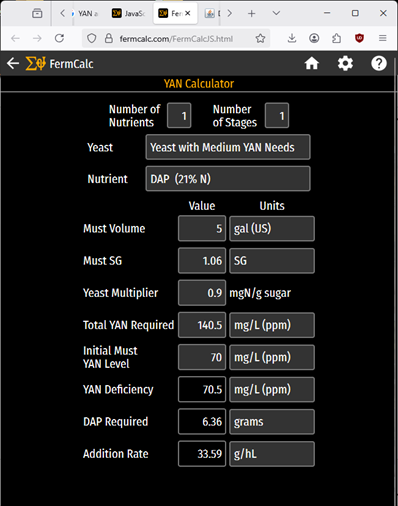
NOTE: Use FermCalc (www.fermcalc.com) to guide you in making additions with DAP, Fermaid, or other nutrient sources.  Shown below is the calculation for 5 gal of juice at a specific gravity of 1.06, whose measured YAN was 70 mg/L, showing that 6.36 g of DAP is needed in this case

fermcalc yan calculator

Posted on Leave a comment

Who are we?

You all know by know what our company does. Have you heard the story of how we started? Officially opening up in January 2010, Vinmetrica was founded on the belief that Rich could put together products that would help winemakers like him. After a series of events involving several years of working as a research scientist at Eli Lilly, a move to Northern California and eventually an over abundance of apricots off a tree in Rich’s new backyard, the idea for Vinmetrica was born.

Rich followed the typical progression of the home winemaker we still encounter today. He began making apricot jam but had so much excess fruit that he decided to try his hand at winemaking and the eventual study of fermentation chemistry. Graduating from fermenting fruit to condensed juices, then to wine kits and finally to grapes. After a while he was confronted with the task of measuring sulfite levels.

With a background in analytical chemistry, Rich had a thorough understanding of measuring sulfite levels via the Ripper titration method and after a quick visit to a local winemaking store Rich returned with some Chemetrics Titrets. Despite knowing that they were not all that suitable for red wines, Rich kept trying to use them for a whole season before finally giving up… Determining the endpoint was not reproducible. There had to be another way!

Eventually landing on the iodine titrations Rich had done as an undergraduate he remembered how he could see a faint yellow iodine color about the same time as his cobbled together electrode system read an endpoint. This was all a lesson in using electrochemistry to detect an endpoint rather than a color indicator. And thus Vinmetrica, or at least the idea for it, was born.

Two platinum electrodes, disused equipment at work, a few components from Fry’s Electronics, and an output that he read with his voltmeter.. that’s how it all started. Wasn’t much to look at, but he found he could get reproducible results in minutes. This was about 1995. He used this setup for years in his garage.

Then, in 2008, after being let go from a position as the VP of Reagents and Assays at Molecular Devices and with a little bit of encouragement from his wife, Rich decided to start Vinmetrica. The company was founded on Rich’s desire to make the vintner’s job easier and more predictable.

His first task was to hire some employees so he hired his two sons (Richie & Tim) to fulfill various positions and needs for the company, as they could pop in and out easily while still attending college. As the company grew, his need for additional employees also grew and he eventually hired one of his step daughters (Karolyn) but she was about to leave for a study abroad program, so he decided to hire his other step daughter (Taylor) to fill the position as she had just graduated from college with a degree in Biology. And finally, the last family hire was Rich’s stepson (Bryan), who joined us for a few years after he graduated college. Throughout the past 13 years, Vinmetrica has only hired one non family member (Rachel). She was with us for several years before moving on to bigger things.

These days, our entire operation is family owned and operated; being completely ran by Rich, Taylor and Tim (with some IT help from Richie occasionally). We have expanded from a small operation selling direct to customers to now having over 10 distributors in the US plus 8 international distributors. Every item we sell comes through the doors of our warehouse in Carlsbad, CA before it is loving packaged and sent out.

When we say we are a small business, we mean it! And we thank our customers each and every day for supporting us! We wouldn’t be here without you.

Posted on 2 Comments

Some updates on the Vinmetrica SO2 test

We have some new information regarding the use of the Vinmetrica SO2 test on the SC-100A or the SC-300.  This information is also referenced in the latest versions of the manuals, which you can always access here:  Manuals On-line

  1. Running SO2 standards to check accuracy:

Sometimes we are asked if there is a way to check or calibrate the Vinmetrica free SO2 test, to make sure it’s accurate. The short answer is yes, but it’s tricky, and you generally don’t need to do so. “Calibration” is built into the SO2 reagents in the form of the SO2 Titrant, whose concentration is carefully controlled (at 0.0156 N, so that each mL used equals 20 ppm of SO2).  The reagents are quite stable up to and even beyond their stated expiration date.

If you want to try checking the accuracy of your SO2 titration, you can prepare “standards” of known concentration. The following link will lead you to the methods that we recommend for preparing SO2 standards: SO2 Standardization Check

This describes how to use potassium metabisulfite (KMBS) or preferably, sodium sulfite as a standard.  It also describes an alternative method that uses vitamin C (ascorbic acid) as a substitute for SO2.

As mentioned, the methods are a bit tricky to get good results. We won’t go into details for now, but if you look it up and have questions, we’re always here to help!

  1. Running Total SO2 tests:

Total SO2 tests are usually not necessary for most purposes of controlling wine oxidation and stability.  Sometimes commercial export requirements call for a total SO2 test, and sometimes winemakers want to know if total SO2 is creeping up in the background; for health and safety, the TTB has a limit of 350 ppm for total SO2.

The Vinmetrica method for total SO2 has a simple variation on the free SO2 method. You add 10 mL 1N sodium hydroxide (NaOH) to a 25 mL wine sample, cover the vessel to restrict air access, and let react 20 minutes with occasional or constant stirring.  At the end of this time, you add 8 mL (instead of the usual 2 mL) of your Acid Solution, 2 mL of the Reactant, then proceed with the normal SO2 titration.

What’s new here is that in the past we recommended a 10 minute reaction time with the sodium hydroxide.  We have found that in some cases, that resulted in a slightly lower value compared with a 20 minute time period.  Using reaction times longer than 20 minutes does not seem to make any difference.

Posted on 1 Comment

Stuck Fermentations

Primary Fermentation

Stuck primary fermentations in winemaking refer to a situation where the fermentation process slows down or stops before all the available sugars are converted into alcohol and carbon dioxide. This can be a common challenge for winemakers and may result in an incomplete or unbalanced wine. Several factors can contribute to stuck fermentations, and it’s essential to identify and address them promptly.

Common Causes of Stuck Fermentations:

    1. Temperature Fluctuations: Yeast activity is highly sensitive to temperature. If the temperature is too low, the yeast may become sluggish or dormant. Conversely, if it’s too high, it can stress the yeast and lead to stuck fermentation.
    2. Nutrient Deficiencies: Yeast requires various nutrients to thrive, such as nitrogen, vitamins, and minerals. A lack of essential nutrients can hinder yeast metabolism and lead to a stuck fermentation.
    3. Inadequate Aeration: Yeast needs oxygen during the early stages of fermentation. Insufficient aeration can limit yeast growth and fermentation progress.

Keep Reading More!

Posted on Leave a comment

Some notes on sulfites, pH and TA

Since harvest is again upon us all, we at Vinmetrica thought it would be a good time to share a few tips on measuring and adjusting the three key parameters you need as fermentation begins and shortly after: pH, TA and free SO2.

First, just a reminder that we have lots of information on our web site (www.vinmetrica.com).  You might want to browse through our Support section on the home page.  There you can find useful resources like videos, the latest version of the manual for your instrument, and our troubleshooting guide.

Second, we recommend you look through the latest version of your manual to refresh your memory as needed!

Measuring and adjusting pH and TA

Measuring pH is technically simple.  You calibrate your pH electrode, then insert it into the wine sample, let it equilibrate a few seconds and take the reading.  Here are some tips to keep it from going awry. Keep Reading More!

Posted on Leave a comment

pH 4.01 to pH 4.00 Label Update

The pH 4 reference solution (for use with the SC-200 or SC-300 unit + pH electrode) is now labeled as 4.00, the correct reference value at a temperature of 20 ℃ (68 ℉).  The chemical composition of the solution itself is unchanged from before, and its reference value is still 4.01 at 25 ℃ (77 ℉). It’s just that since most of us work on wine or other beverages that are closer to 15 to 20 ℃ (59 to 68 ℉), a value of 4.00 is slightly more accurate than 4.01. Instruments that use the old reference value 4.01 rather than the new value of 4.00 do not produce significant error: less than 0.02 pH difference in wines with pH values from 3.00 to 4.00.

As mentioned in a recent newsletter, we have a new update to the firmware for SC-200s and -300s built after 2015 (Serial numbers 2897 and above for SC-300s, 470 and above for SC-200s).  This new firmware, versions 3.2.F (or 2.2.F for an SC-200) and higher, uses the value of 4.00 instead of 4.01 for pH calibration.  All new units being shipped will now have this new firmware version installed on them. If your instrument has a lower serial number, or an earlier version of firmware, it will set the pH 4 reference to 4.01 as usual.

Posted on 1 Comment

Testing for Fruit and Other Non-Grape Wines and Fermentations

apple cider in glass fermentingPeriodically we get asked about making non-grape wines and if/how our equipment can test for the same parameters when different fruits, vegetables or flowers are used. We thought we would  explain how the test kits that we offer may need to be adapted to test a non-grape wine.

Country wine, as it’s commonly called, is wine made from something other than grapes. We have customers that make mead, cider, kombucha, jalapeno wine, blueberry wine, and dozens of other fruit combinations. They have had much success using several of our testing kits.  We note that some analyses require adjustments to the calculations and/or procedures to get useful results.  In rare cases,  some of the tests cannot be used because of interferences. Keep Reading More!

Posted on 1 Comment

Sulfites and Headaches – Is there a correlation?

This is a regularly debated topic that deserves some attention. We’d like to refer you to a great blog by Andrew Waterhouse at UC Davis that breaks down all aspects of the “sulfite gives me headaches” conundrum. Below, we have summarized it for you, but briefly, sulfites are unlikely to cause that headache that some people report occurring within a few hours of consuming wine.

As most winemakers know, sulfite or sulfur dioxide is an anti-oxidant preservative used in winemaking that can also help protect your wine from harmful bacteria or other non-desirable things that might make their way into your barrel. Did you know it is also used to preserve dried fruits? Keep Reading More!